Bell pepper export succeeds or fails on details: the colour stage at harvest, the hours between field and cold room, the carton, the temperature in transit. This guide walks through bell pepper export from Tanzania in nine proven steps, with the grades, temperatures, packing and documents an importer needs to plan a programme, including buyers in Israel, the Gulf and Europe.
It is written for importers, wholesalers, supermarket buyers and food-service distributors. For current colours and weekly availability, see our bell peppers product page.
Bell pepper export at a glance
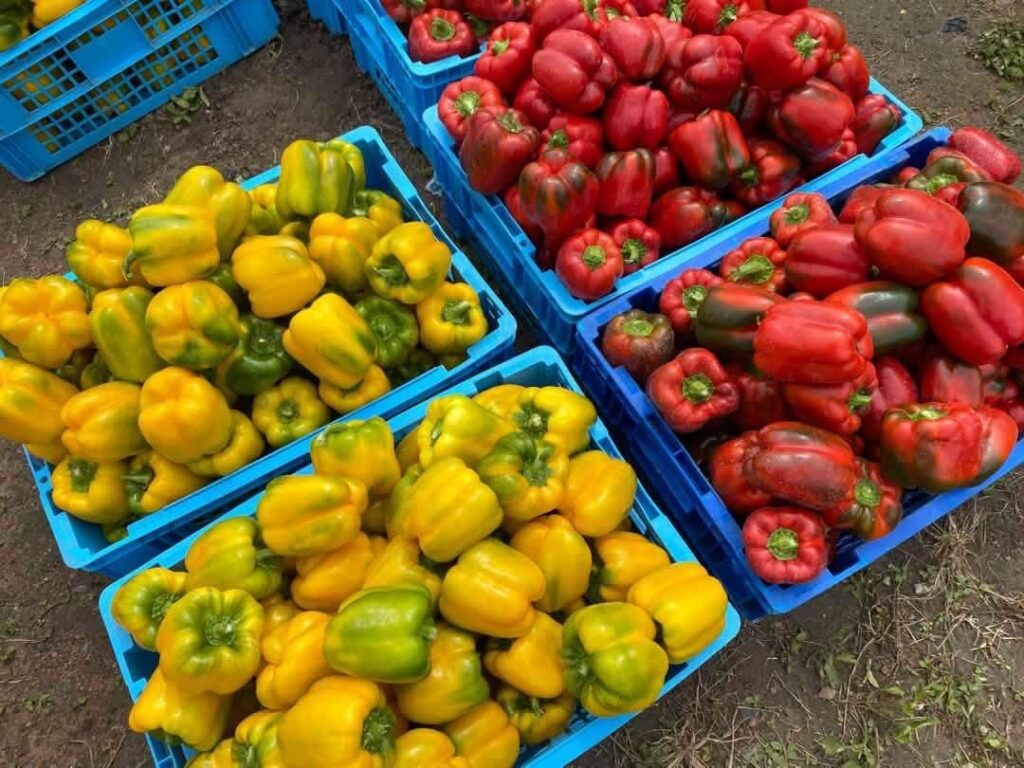
- Product: blocky sweet peppers in red, yellow and green, with orange on request.
- Origin: irrigated farms in the Arusha and Kilimanjaro highlands of Tanzania.
- Standard: UNECE sweet pepper standard; Class I is usual for retail bell pepper export.
- Sizes: M 60–80 mm, L 80–100 mm, XL 100 mm and above.
- Cold chain: 7–10 °C at 90–95% relative humidity from packhouse to buyer.
- Shelf life: about ten to fourteen days from harvest.
- Packing: 5 kg ventilated cartons or 10 kg crates.
- Freight: air for coloured peppers and distant markets; reefer container where transit is short.
- Documents: phytosanitary certificate, certificate of origin, invoice, packing list, transport document, and the importer’s permit where required.
- Lead time: a trial by air can usually be arranged in two to three weeks; a planted programme needs three to four months of notice.
The rest of this guide takes each of these points in turn, so that your first bell pepper export order arrives fresh and clears without delay. Most problems with bell pepper export trace back to one of the items above being left unsaid, so use the list as an agenda for your first call with the trade desk.
Why source bell peppers from East Africa?
The northern highlands of Tanzania, around Arusha and Kilimanjaro, sit close to the equator at altitude. Days are warm, nights are cool and day length hardly changes through the year. With irrigation, peppers can be planted and harvested in every month.
For an importer that means two advantages. First, supply does not stop in the northern winter, when production in Europe and the Mediterranean falls and prices rise. Second, the region has an established horticulture industry, with packhouses, cold stores and regular air and sea freight from Kilimanjaro, Nairobi, Dar es Salaam and Mombasa.
Bell pepper export from the region is still small compared with green beans or avocado, which gives buyers room to build direct programmes with growers.
Step 1: Choose the colours and varieties
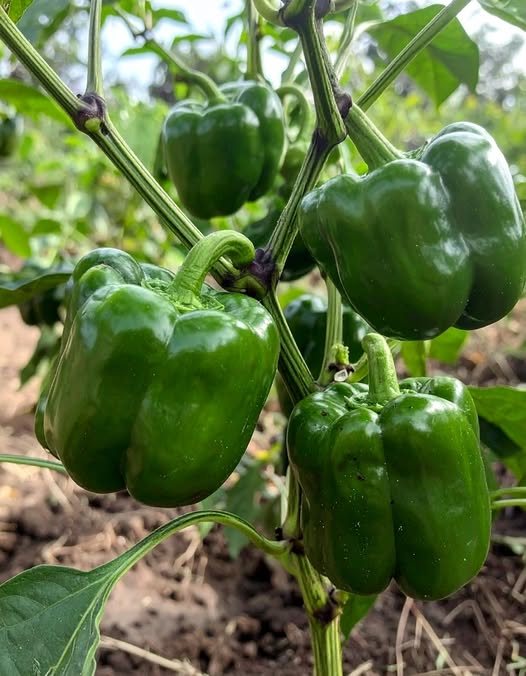
A bell pepper’s colour is a stage of ripeness as much as a variety. Every pepper starts green. Left on the plant, it turns red, yellow or orange depending on the variety.
| Colour | Stage | Flavour | Shelf life |
|---|---|---|---|
| Green | Mature but unripe | Fresh, slightly bitter | Longest |
| Red | Fully ripe | Sweetest | Shorter |
| Yellow | Fully ripe | Mild and sweet | Shorter |
| Orange | Fully ripe | Sweet and fruity | Shorter |
Coloured peppers stay on the plant two to three weeks longer than green ones, so they yield less and cost more. Blocky, four-lobed varieties are the international standard for retail. Tell us the mix you want: single colour, or “traffic light” packs of red, yellow and green.
Step 2: Agree the class and size
International trade in sweet peppers follows the standard published by the United Nations Economic Commission for Europe (UNECE), which European marketing rules mirror. It defines three classes.
- Extra Class: superior quality, practically free of defects, uniform in shape and colour.
- Class I: good quality, with slight defects in shape or skin allowed. This is the usual grade for supermarket bell pepper export.
- Class II: sound peppers with more defects in shape, colour or skin, suitable for wholesale markets and processing.
All classes must be whole, sound, clean, fresh in appearance, firm, and free of pests and damage, with the stalk attached.
Size is measured by the diameter across the shoulder or by weight. The ranges we pack are:
| Size | Shoulder diameter | Approximate weight |
|---|---|---|
| M | 60–80 mm | 130–180 g |
| L | 80–100 mm | 180–250 g |
| XL | 100 mm and above | 250 g and above |
Step 3: Harvest at the right moment
Peppers do not ripen much after picking. Unlike tomatoes, a pepper harvested half-coloured will stay half-coloured. For bell pepper export the rule is simple: pick at the colour the customer will sell.
- Green peppers are picked full-sized, firm and glossy, with thick walls.
- Coloured peppers are picked at 80–100% colour for air freight and nearby markets, and slightly earlier for longer journeys.
Harvest is done in the cool of the morning. Fruit is cut, not pulled, so that the green stalk stays attached and the shoulder is not torn. Pickers use shallow crates to avoid crushing.
Step 4: Cool the fruit quickly
Field heat is the enemy. A pepper at 30 °C loses water and softens several times faster than one at 10 °C. In a well-run bell pepper export operation, fruit reaches the packhouse within a couple of hours of cutting and is brought down to storage temperature by forced-air cooling.
The target conditions are the same from packhouse to destination:
| Factor | Target | Why |
|---|---|---|
| Temperature | 7–10 °C | Slows ageing without chilling injury |
| Relative humidity | 90–95% | Prevents shrivelling |
| Ethylene | Keep away | Speeds colour change and softening |
Below about 7 °C, peppers suffer chilling injury: pitting, water-soaked patches and seed browning that often appear only after the fruit is back at room temperature. Never ship peppers in the same container as produce that needs near-freezing temperatures.
Step 5: Sort and pack for the journey
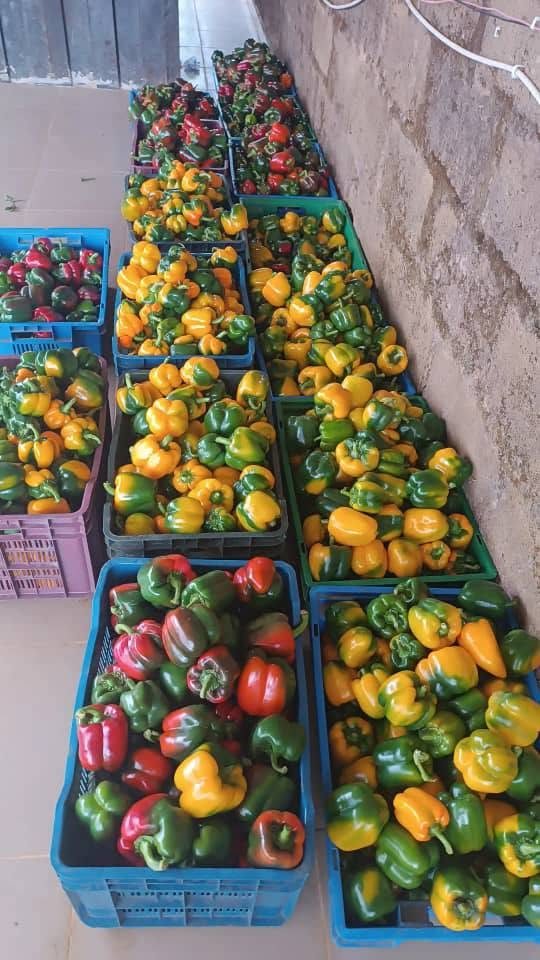
In the packhouse, peppers are washed or brushed, dried, and sorted by colour, size and class. Fruit with sunscald, cracks, blossom-end rot, insect damage or soft spots is removed.
Packing options for bell pepper export are:
- 5 kg ventilated cartons, the standard for retail and air freight, single colour or mixed.
- 10 kg ventilated plastic crates, for regional wholesale and food service.
- Flow-wrapped retail packs of two or three peppers inside a master carton, on request.
Cartons carry the product name, class, size, colour, net weight, country of origin and a traceability code linking the box to the farm and harvest date. Pallets are built so that air can move through the stack.
Step 6: Pick air freight or sea freight
Peppers keep for about ten to fourteen days under ideal conditions, and that clock decides the route.
| Air freight | Sea freight (reefer) | |
|---|---|---|
| Transit time | One to two days | From about a week to several weeks, by route |
| Best for | Coloured peppers, distant markets | Green peppers, nearby ports |
| Minimum | One pallet | One reefer container |
| Cost per kg | Higher | Lower |
| Load | By pallet | About 6–7 tonnes (20 ft); 12–14 tonnes (40 ft) |
For most destinations outside the region, coloured peppers travel by air. Sea freight works where the voyage and inland handling together fit inside the shelf life, with a margin for the retailer. We advise on the route when we quote.
Step 7: Meet plant health and food safety rules
Every bell pepper export consignment needs a phytosanitary certificate from the national plant protection authority of the exporting country. Beyond that, each destination adds its own requirements.
- European Union and United Kingdom: peppers are subject to plant health controls and strict maximum residue limits for pesticides. Retailers usually require GLOBALG.A.P. certified farms.
- Israel: fresh produce needs an import permit from the plant protection service, obtained by the importer, and inspection on arrival. Our guide to exporting to Israel covers the steps.
- Gulf states: a phytosanitary certificate, certificate of origin and compliance with Gulf labelling and residue standards.
- United States: fresh peppers are admitted only from approved origins under specific conditions, so check admissibility first. See exporting to the United States.
Rules change, and they are applied at the border, not on paper. Ask your customs agent to confirm the current requirements before the first shipment. The Food and Agriculture Organization hosts the international plant protection framework that these certificates follow.
Step 8: Fix the commercial terms
Fresh produce prices move every week with weather, supply and demand. A bell pepper export programme therefore fixes the framework and leaves the weekly price to be confirmed.
Agree these points in writing:
- Colours, class and size range.
- Packing and labelling.
- Weekly volume and the length of the programme.
- Delivery term: FOB airport or port, or CIF your destination. See EXW, FOB or CIF explained.
- How and when the weekly price is set.
- Payment terms.
- The quality standard on arrival and the time limit for claims, with photographs and an inspection report.
Our trade terms set out how we handle quotations, inspection and claims.
Step 9: Start with a trial and scale up
The safest way to begin is a trial shipment of one or two pallets by air. It tests the whole chain: grower, packhouse, airline, customs clearance and your own cold store. Check temperature records, weight loss and the condition of the fruit on arrival and again after a few days of shelf life.
When the trial works, move to a weekly programme. Regular volumes let the grower plant for you, which improves consistency and price. Many buyers add other lines from the same area once the route is proven, such as tomatoes and Irish potatoes; our Irish potato export guide follows the same step-by-step approach.
Common problems in bell pepper export and how to avoid them
| Problem on arrival | Usual cause | Prevention |
|---|---|---|
| Shrivelled, soft fruit | Water loss from slow cooling or low humidity | Fast pre-cooling; 90–95% humidity |
| Pitting, dark seeds | Chilling injury below 7 °C | Set and record 7–10 °C throughout |
| Soft rot at the stalk | Wet fruit, damaged stalks | Dry before packing; cut, do not pull |
| Uneven colour | Picked too early | Harvest at agreed colour stage |
| Rapid colour change | Ethylene from mixed loads | Do not ship with ripening fruit |
| Bruising | Deep crates, rough handling | Shallow crates, strong cartons |
Bell pepper export to Israel and the Gulf: practical notes
Much of our bell pepper export goes to buyers in Israel and the Gulf. These points come up on almost every first order.
- Import permit first. In Israel the importer applies for a plant import permit before shipment. The permit lists the conditions the consignment must meet, and the phytosanitary certificate we provide has to match it exactly, including the botanical name and the place of production.
- Inspection on arrival. Consignments are inspected at the port or airport. Clean fruit, free of soil, leaves and insects, clears faster.
- Labelling. Cartons should show the product, origin, packer, net weight and lot code in the form the importer specifies. Some buyers ask for their own carton design.
- Counter-season demand. Local production in Israel and the Gulf is seasonal and affected by summer heat. Imported peppers fill the gaps, so programmes are often seasonal rather than year-round.
- Air freight routing. Shipments move through Kilimanjaro, Dar es Salaam or Nairobi with a connection in a regional hub. We book space once the weekly volume is confirmed.
For other destinations in the region, see our guide to Asia and the Middle East.
What makes up the landed cost
When you compare bell pepper export offers, look at the full cost of getting a kilogram of saleable fruit onto your shelf, not only the farm price.
| Cost element | What it covers |
|---|---|
| Product price | Fruit sorted to the agreed class, size and colour |
| Packing | Cartons, liners, labels, pallets |
| Packhouse and cooling | Sorting, pre-cooling, cold storage |
| Inland transport | Refrigerated truck to airport or port |
| Export clearance | Phytosanitary inspection, documents, handling |
| Freight | Air freight per kilogram, or reefer container rate |
| Insurance | Cover in transit |
| Import costs | Duty, inspection fees, clearance, local delivery |
| Shrinkage | Weight loss and fruit rejected after arrival |
Freight is usually the largest single item for air shipments, which is why carton weight, pallet height and consistent weekly volumes make such a difference to the final price. Shrinkage is the cost buyers most often forget. A slightly dearer supplier with a reliable cold chain is normally cheaper per kilogram actually sold.
Planning a bell pepper export programme through the year
Peppers take roughly three to four months from transplanting to first harvest, and a planting then crops for several weeks. A grower therefore needs notice to supply a new customer.
- Three to four months ahead: agree colours, volumes and start date so that planting can be scheduled.
- One month ahead: confirm packing, labelling, permits and the freight route.
- Two weeks ahead: send a trial shipment and review the arrival.
- Weekly during the programme: confirm the order and price, and share arrival quality reports with the packhouse.
- End of programme: review performance and book the next season.
Buyers who can commit to a programme usually get first call on supply when the market is short.
First-shipment checklist
- Import permit obtained and copied to the exporter.
- Specification signed: colours, class, sizes, packing, labels.
- Temperature setting agreed and a data logger placed in the load.
- Phytosanitary certificate details checked against the permit.
- Airway bill or bill of lading, invoice, packing list and certificate of origin received before arrival.
- Customs agent briefed and cold storage booked at destination.
- Arrival inspection planned, with photographs and weights recorded.
Working through this list before the first bell pepper export consignment leaves saves days at the border.
Frequently asked questions about bell pepper export
Are bell peppers available from Tanzania all year?
Yes. Irrigated production in the highlands runs throughout the year, with volumes that rise and fall by season.
What is the minimum order?
About 500 kg per colour for regional delivery or one pallet by air. Sea freight needs a full reefer container.
What temperature should bell peppers be shipped at?
7–10 °C with 90–95% relative humidity.
How long do bell peppers last?
About ten to fourteen days from harvest under continuous cold chain. Green peppers last longest.
Can you ship mixed colours?
Yes. Mixed cartons and mixed pallets of red, yellow and green are common.
Do you supply buyers in Israel?
Yes. Israel is one of our main markets for bell peppers and Irish potatoes. The importer arranges the import permit and we provide the phytosanitary certificate and origin documents.
Which class do supermarkets buy?
Normally Class I, with defined sizes and colours.
How do I get a price?
Send the colours, sizes, weekly volume and destination from the bell peppers page or the contact page. We reply with the current weekly price and the next loading date.
How far ahead should I plan a bell pepper export programme?
For spot purchases from existing plantings, two to three weeks is usually enough to arrange a trial. For a dedicated weekly programme in specific colours and sizes, give three to four months of notice so that the grower can transplant for your start date. Earlier notice also helps us reserve air-freight space in busy weeks.
What documents arrive with a bell pepper export shipment?
The phytosanitary certificate, certificate of origin, commercial invoice, packing list and the airway bill or bill of lading. Copies are sent before arrival so that your customs agent can prepare clearance.
Summary
Bell pepper export is a cold-chain business. Choose the colours and class, harvest at the right colour stage, cool within hours, hold at 7–10 °C and 90–95% humidity, pack in ventilated cartons and match the freight mode to the shelf life. Get the phytosanitary and import paperwork right for the destination, start with a trial and build to a weekly programme.
Tanzania’s highlands can supply red, yellow and green peppers in every month of the year. A well-planned bell pepper export programme gives your customers steady quality when other origins are out of season. Tell us what you need and we will plan the first shipment with you.